
 The Energy Report
Notable Quotes
"With the LOI signed, we urge investors to bolster positions in FCU." (12/22/15) Fission Uranium Corp. - David Sadowski, Raymond James More >
"FCU is taking the right steps regardless of whether PLS is ultimately acquired or developed into a mine." (12/22/15) Fission Uranium Corp. - Heiko Ihle, Rodman & Renshaw More >
"I am quite excited about POE in 2016." (12/16/15) Pan Orient Energy Corp. - Chen Lin, What Is Chen Buying? What Is Chen Selling? More >
"BKX's Oklahoma asset has significant value." (12/16/15) BNK Petroleum Inc. - Michael Charlton, iA Securities More >
"EFR is one of the few companies in a position to write long-term sales contracts and deliver into them at several times its current production rate." (12/17/15) Energy Fuels Inc. - The Gold Report Interview with Eric Coffin More >
Natural Gas: The Realistic Choice
|
Energy Strategist (08/23/2010)
Natural gas prices have been depressed for more than a year, and stocks levered to the fuel have turned in a mixed performance. This weakness has led many investors to the unfortunate conclusion that natural gas isn't an interesting investment story. Nothing could be further from the truth. Gas, an abundant and environmentally friendly fuel, is already revolutionizing key global energy industries like petrochemicals. And nat gas is a far more viable alternative to oil in the transportation sector than any other widely hyped alt energies. Natural Gas: The 21st Century Fuel The two main sources of natural gas demand are electric power generation and industrial applications. The key question is why companies would choose to use gas to produce electric power, as an industrial fuel, or as feedstock rather than coal and oil. In markets where natural gas competes with oil, gas' main advantages are its ready availability and lower price. The following chart shows the price of crude oil compared to U.S. and UK nat gas prices. 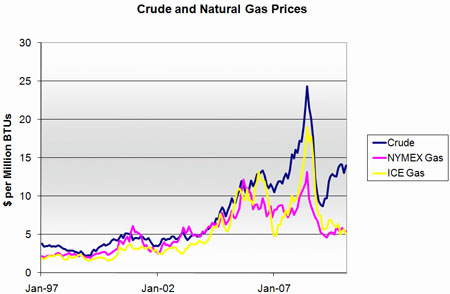 Natural gas is considered a regional fuel. The U.S., for example, has obtained its gas from a combination of domestic production and imports from Canada. Although gas imported from further afield in the form of LNG has become a more meaningful component of N. American supply in recent years, it's still a relatively small part of the supply mix. Similarly, Europe has traditionally obtained most of its gas from North Sea production and via pipeline from Russia. As a result, nat gas prices can differ widely between world regions. Greater availability and reliability of supply means natural gas prices will remain relatively cheap vs. oil. From 1996–2006, the ratio of U.S. oil to U.S. natural gas prices on an energy-equivalent basis averaged 1.2-to-1. Transport is a huge potential growth market for natural gas. The U.S. consumes around 9M bbl/d in the form of motor gasoline alone. On an energy-equivalent basis, that's more than 50 bcf of natural gas equivalent per day. When you consider that total current U.S. consumption is around 60 bcf per day, replacing even a small part of the gasoline market with natural gas would imply an enormous increase in total natural gas demand. |
 PRINT THIS PAGE
 EMAIL THIS PAGE
Under SEC rules, analysts are required to disclose their interest in securities that they cover. We strongly encourage you to contact them to understand any potential conflicts of interest they may have.
More Experts
"FCU's deal with CGN helps to financially and technically derisk PLS." (12/21/15) Fission Uranium Corp. - David Talbot, More >
"NXE is our top pick across all commodities." (12/22/15) NexGen Energy Ltd. - The Energy Report Interview with Rob Chang More >
"FCU will continue to explore and add pounds to what is already a world-class project." (12/22/15) Fission Uranium Corp. - The Energy Report Interview with Rob Chang More >
"EFR is well positioned to benefit from higher uranium prices." (12/22/15) Energy Fuels Inc. - The Energy Report Interview with Rob Chang More >
"FCU intends to sell $82M or 19.9% of the company to CGN Mining." (12/22/15) Fission Uranium Corp. - Jeb Handwerger, Gold Stock Trades More >