
 The Energy Report
Notable Quotes
"With the LOI signed, we urge investors to bolster positions in FCU." (12/22/15) Fission Uranium Corp. - David Sadowski, Raymond James More >
"FCU is taking the right steps regardless of whether PLS is ultimately acquired or developed into a mine." (12/22/15) Fission Uranium Corp. - Heiko Ihle, Rodman & Renshaw More >
"I am quite excited about POE in 2016." (12/16/15) Pan Orient Energy Corp. - Chen Lin, What Is Chen Buying? What Is Chen Selling? More >
"BKX's Oklahoma asset has significant value." (12/16/15) BNK Petroleum Inc. - Michael Charlton, iA Securities More >
"EFR is one of the few companies in a position to write long-term sales contracts and deliver into them at several times its current production rate." (12/17/15) Energy Fuels Inc. - The Gold Report Interview with Eric Coffin More >
U.S. Natural Gas
|
Energy Strategist (08/18/2010)
Above-average temperatures this summer and storms in the GOM have produced some spikes in North American natural gas prices over the past three months; but, generally speaking, the market remains depressed. Natural gas has averaged $4.50/Mbtu since the end of the first quarter. But U.S. gas storage levels have increased at a slower pace. 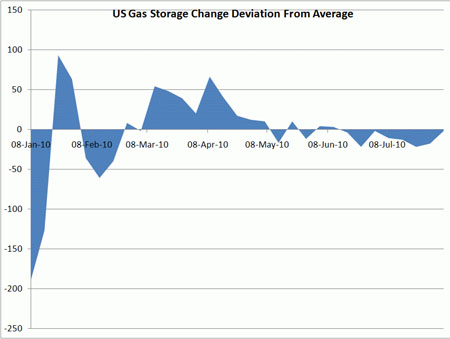 Source: Energy Information Administration This graph tracks weekly gas storage statistics compared to the five-year average. Negative numbers indicate gas in storage is either falling at a faster-than-normal pace or rising at a slower-than-average rate. As you can see, the cold winter of 2009–2010 drove above-average gas consumption for heating and pushed storage levels sharply lower. But any gains made during the winter months were immediately reversed during the spring shoulder season, a period of weak gas demand. U.S. gas production increased throughout the year, but abnormally cold winter weather masked this growth; as soon spring sprung, excess production began to show up in weekly storage statistics again. This summer has yielded consistently bullish storage statistics, returning inventories to normal levels. 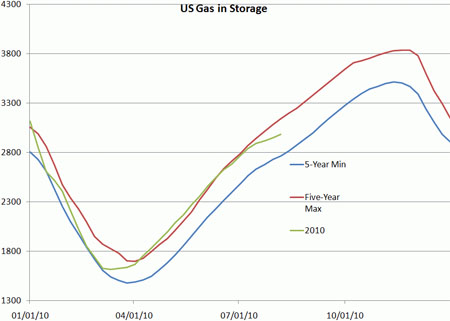 Source: Energy Information Administration In this graph the blue line represents the five-year minimum storage level; the red line, the five-year maximum; and the green line, the current path of storage. Starting in April, U.S. gas in storage set new seasonal records up through July 1. Around this time—just when Americans are firing up air-conditioning units—the green line begins to trend toward normal levels; storage is about 7.9% above the five-year average but 5% below the level in 2009. The short-term concern for gas: Summer weather will keep demand high for a few more weeks, but the fall shoulder season presents problems. |
 PRINT THIS PAGE
 EMAIL THIS PAGE
Under SEC rules, analysts are required to disclose their interest in securities that they cover. We strongly encourage you to contact them to understand any potential conflicts of interest they may have.
More Experts
"FCU's deal with CGN helps to financially and technically derisk PLS." (12/21/15) Fission Uranium Corp. - David Talbot, More >
"NXE is our top pick across all commodities." (12/22/15) NexGen Energy Ltd. - The Energy Report Interview with Rob Chang More >
"FCU will continue to explore and add pounds to what is already a world-class project." (12/22/15) Fission Uranium Corp. - The Energy Report Interview with Rob Chang More >
"EFR is well positioned to benefit from higher uranium prices." (12/22/15) Energy Fuels Inc. - The Energy Report Interview with Rob Chang More >
"FCU intends to sell $82M or 19.9% of the company to CGN Mining." (12/22/15) Fission Uranium Corp. - Jeb Handwerger, Gold Stock Trades More >