
 The Energy Report
Notable Quotes
"With the LOI signed, we urge investors to bolster positions in FCU." (12/22/15) Fission Uranium Corp. - David Sadowski, Raymond James More >
"FCU is taking the right steps regardless of whether PLS is ultimately acquired or developed into a mine." (12/22/15) Fission Uranium Corp. - Heiko Ihle, Rodman & Renshaw More >
"I am quite excited about POE in 2016." (12/16/15) Pan Orient Energy Corp. - Chen Lin, What Is Chen Buying? What Is Chen Selling? More >
"BKX's Oklahoma asset has significant value." (12/16/15) BNK Petroleum Inc. - Michael Charlton, iA Securities More >
"EFR is one of the few companies in a position to write long-term sales contracts and deliver into them at several times its current production rate." (12/17/15) Energy Fuels Inc. - The Gold Report Interview with Eric Coffin More >
A ~50% Meltdown in U.K. Oil Production
|
PAVEL MOLCHANOV, Raymond James
(04/26/2010)
"Who do you think has been worse for their country's oil industry: Tony Blair or Hugo Chavez? Come to think of it, it is kind of an unfair comparison—unfair to Chavez! We'll let political historians judge the Labor era's legacy for the U.K. overall, but as far as the oil industry goes, it's a no-brainer. Over the past decade-plus, the U.K. has experienced an oil production meltdown of horrendous proportions—yes, even worse than Venezuela's. When Tony Blair first became prime minister in 1997, the U.K. produced 2.7 MMbpd, of which nearly 1 MMbpd was exported. By 2009, the U.K. was producing 1.5 MMbpd—a 46% decline over a 12-year period, an average of 5% per year. As a result, in 2004 the U.K. recorded its first petroleum trade deficit in 13 years, and in 2006 became a net importer on a sustained basis. In 2009, the U.K. imported roughly 0.2 MMbpd, with the import requirement likely to double by 2012. While the U.K. remains one of the most self-sufficient industrialized countries when it comes to oil supply, its status as textbook mature oil producer means that production is heading in only one direction: Down Why is North Sea oil production in meltdown? As shown below, U.K. oil production peaked in 1999 and has declined every year since, except 2007. From 1999 to 2009, U.K. output was essentially cut in half—down 49%. For some perspective, Venezuelan output declined “only� 40% in the same period. Norway has fared badly, though not quite as badly. Norwegian production has declined 30% since peaking in 2001. In the aggregate, output from the two main North Sea producers fell by 2.1 MMbpd between 1997 and 2009—more than wiping out the total growth from Canada and Brazil (1.9 MMbpd) over the same period. While Norway remains a top five oil exporter due to its very low population, the U.K. ceased exporting for good in 2006, despite having essentially flat demand over the past decade. We project sustained production declines for both countries for the foreseeable future. For 2010, we project a decline of 7% in the U.K. and 5% in Norway. 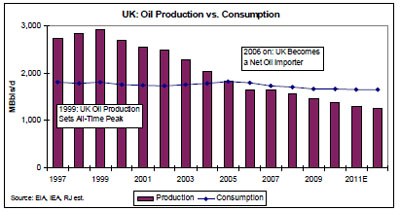 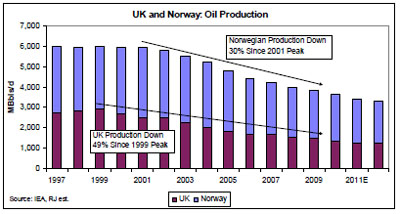 Why is this happening? The short answer is that discoveries of new reserves in the North Sea have simply not been able to keep up with the rate of depletion. Similar to Russia, the 'low-hanging fruit' has largely been picked, and major new discoveries are less and less frequent. The huge discoveries of the 1960s and 1970s—such as the Forties and Ekofisk fields—are simply not being repeated. With finding and development costs creeping upward, the key North Sea producers—primarily the integrated majors—do not have much of an incentive to engage in the exploration that is required to discover large new reserves. Over the past decade, new finds have been far smaller than in the North Sea's heyday. In the near-term, improved recovery from existing fields may offset some of the declines. And certainly, new projects are continually coming online. The underlying problem is that all these additions—in both reserves and production—are inadequate to compensate for organic depletion at existing fields. This is the very definition of a mature oil province, and it is inconceivable that the trend will be reversed over the long run. With the North Sea a full decade past its peak, the only question for the next decade is: How steep will the declines be?"
|
More Experts
"FCU's deal with CGN helps to financially and technically derisk PLS." (12/21/15) Fission Uranium Corp. - David Talbot, More >
"NXE is our top pick across all commodities." (12/22/15) NexGen Energy Ltd. - The Energy Report Interview with Rob Chang More >
"FCU will continue to explore and add pounds to what is already a world-class project." (12/22/15) Fission Uranium Corp. - The Energy Report Interview with Rob Chang More >
"EFR is well positioned to benefit from higher uranium prices." (12/22/15) Energy Fuels Inc. - The Energy Report Interview with Rob Chang More >
"FCU intends to sell $82M or 19.9% of the company to CGN Mining." (12/22/15) Fission Uranium Corp. - Jeb Handwerger, Gold Stock Trades More >